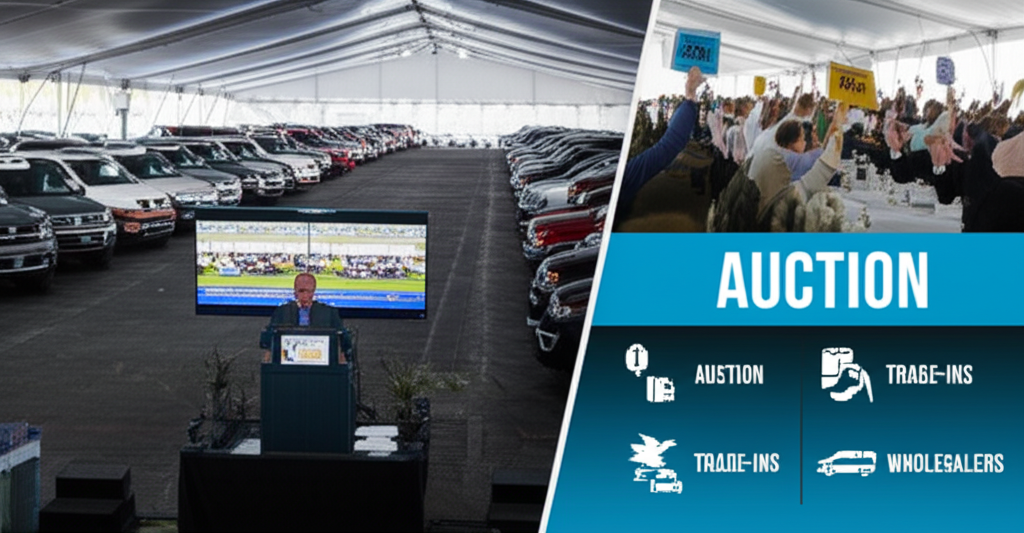
Vehicle Acquisition Strategy: Auctions, Trade-Ins, Wholesalers
Multi-channel vehicle sourcing: auction buying tips, trade-in evaluation, wholesale relationships. Build optimal inventory acquisition mix.
Acquisition cost determines your profit potential before you even start selling. Overpay by $1,500 at acquisition = $1,500 less gross profit at sale (or vehicle sits unsold because you can't price competitively). Successful dealers master three acquisition channels—auctions (volume + consistency), trade-ins (highest margin), and wholesalers (fill inventory gaps)—and know exactly what to pay in each scenario to maintain $2,500-$3,500 gross profit targets.
This guide breaks down acquisition strategies by source, provides maximum bid formulas for auctions, explains trade-in appraisal workflows, and compares cost/ROI across all channels to help you build a diversified acquisition strategy that sustains profitability.
Acquisition Sources Comparison
| Source | % of Inventory | Avg Gross/Unit | Pros | Cons |
|---|---|---|---|---|
| Auctions (Manheim, Adesa, IAA) | 40-50% | $1,800-$2,500 | High volume, consistent supply, graded condition reports, arbitration protection | Competitive bidding drives up prices, transportation costs, can't test drive before purchase |
| Trade-ins (Customer Trades) | 30-40% | $2,500-$4,000 | Highest margin potential, builds customer loyalty, no transportation cost, full inspection before deal | Inconsistent volume (depends on sales traffic), can't choose year/make/model (take what customers offer) |
| Wholesalers (Other Dealers) | 10-20% | $1,500-$2,500 | Fill inventory gaps quickly, negotiable pricing, local (no transport), can inspect in person | Limited selection, vehicles other dealers couldn't retail (condition concerns), no arbitration |
| Private Party | 5-10% | $2,000-$3,000 | Below-market pricing, thorough inspection, ownership history from seller | Time-consuming (negotiate with individuals), no arbitration, title issues risk, scam potential |
| Online Marketplaces (Carvana, Vroom, CarMax) | 5-10% | $1,500-$2,000 | Nationwide inventory access, detailed listings, buy online | Competitive with retail pricing (thin margins), limited negotiation, transportation lag |
Auction Acquisition Strategy
1. Pre-Auction Research
NEVER bid without researching retail value first. Most dealers lose money at auction because they bid emotionally (auction fever) rather than strategically (data-driven max bid).
Research Workflow (24-48 Hours Before Auction):
- Review Auction Listings: Manheim, Adesa, IAA publish vehicle lists 3-7 days before sale date. Filter by year, make, model, mileage matching your target inventory.
- Pull Condition Reports: Read CR (Condition Report) for each target vehicle. Note: CR grade (1.0-5.0, lower = better), mechanical issues, body damage, title status (clean, salvage, rebuilt).
- Check Vehicle History: Run AutoCheck/Carfax for accidents, title brands, odometer rollback, service history.
- Research Retail Value: Search AutoTrader, CarGurus for same year/make/model/trim/mileage within 100 miles. Calculate median retail price.
- Calculate Max Bid: Use formula below. Write max bid on your auction sheet BEFORE bidding starts.
2. Maximum Bid Formula
Formula: (Retail Value × 85%) - Recon Budget - Transport Cost = Max Bid
Example Calculation:
- Vehicle: 2022 Honda Accord EX-L, 38k miles
- Retail Median: $24,500 (researched via AutoTrader comps)
- Recon Budget: $800 (brakes, detail, minor cosmetic)
- Transport Cost: $350 (from auction to lot, 150 miles)
Max Bid Calculation:
($24,500 × 85%) - $800 - $350 = $20,825 - $800 - $350 = $19,675 max bid
Profit Projection at Max Bid:
Retail: $24,500
Cost: $19,675 (auction) + $800 (recon) + $350 (transport) = $20,825 total
Gross: $24,500 - $20,825 = $3,675 gross profit
Discipline Rule: If bidding exceeds $19,675, stop bidding. Walk away. Find another vehicle. Auction fever kills profit.
3. Auction Bidding Best Practices
- Arrive Early, Inspect Vehicles: Physical inspection (start engine, check fluids, test electronics) reveals issues CR missed. Walk away from vehicles with undisclosed problems.
- Set Proxy Bids (Online Auctions): Enter max bid in advance, let system bid for you. Avoids emotional overbidding in live auction environment.
- Avoid First 10-15 Vehicles: Early auction vehicles often bid higher (dealers excited, competitive). Wait until mid-auction when competition thins.
- Focus on If-Bids: "If-bid" vehicles (didn't meet reserve in previous lane) often sell $500-1,500 below market due to seller urgency.
- Know Arbitration Policies: Manheim, Adesa offer 1-5 day arbitration (return vehicle if undisclosed issues found). Review policy, document issues immediately after pickup for arbitration claim.
4. Condition Report Grading (Manheim Scale)
| CR Grade | Condition | Bidding Strategy |
|---|---|---|
| 1.0-1.9 | Excellent (like new, minimal wear) | Bid up to 90% of retail (premium condition justifies higher cost) |
| 2.0-2.9 | Good (clean, minor wear, retail-ready) | Bid up to 85% of retail (standard acquisition target) |
| 3.0-3.5 | Average (visible wear, needs reconditioning) | Bid up to 80% of retail (factor higher recon cost) |
| 3.6-4.0 | Below Average (significant wear/damage) | Bid up to 75% of retail OR avoid (recon cost may exceed profit potential) |
| 4.1-5.0 | Poor (major damage, mechanical issues) | Avoid unless wholesale/parts vehicle (not retail-viable) |
Trade-In Acquisition Strategy
Trade-ins offer the highest gross profit potential because customers rarely know true wholesale value. Your goal: Appraise accurately, offer fair wholesale value (customer happy), retain maximum margin (you profitable).
1. Trade-In Appraisal Workflow
Step 1 - Gather Vehicle Information:
- Year, make, model, trim (confirm exact trim via VIN decoder or customer documentation)
- Odometer reading (verify against service records to detect rollback)
- Title status (clean, salvage, rebuilt, lien holder if applicable)
- Service history (maintenance records, dealer service vs DIY)
- Accident history (ask customer, confirm with Carfax/AutoCheck)
Step 2 - Physical Inspection:
- Exterior: Paint (chips, scratches, fading), body panels (dents, rust), glass (cracks, chips), tires (tread depth, even wear), lights (all functional)
- Interior: Seats (tears, stains, wear), carpet/headliner (stains, holes, sagging), dashboard (cracks, warning lights), HVAC (A/C blows cold), odors (smoke, mold, pets)
- Mechanical: Engine (leaks, noises, smoke), transmission (smooth shifts, no slipping), brakes (pad thickness, rotor condition), suspension (worn bushings, leaks)
- Test Drive: Acceleration, braking, steering, unusual noises, warning lights
Step 3 - Valuation Research:
| Valuation Source | Value Type | Use Case |
|---|---|---|
| Kelley Blue Book (KBB) | Trade-in value range | Use "Fair" condition value as starting point (most trades are fair, not excellent) |
| NADA Guides | Trade-in value, wholesale value | Cross-reference with KBB, use as second opinion |
| Manheim Market Report (MMR) | Wholesale auction value (real-time) | Most accurate wholesale value (updated weekly from actual auction results) |
| Black Book | Wholesale value | Used by many dealers, reliable wholesale reference |
Step 4 - Calculate Trade-In Offer:
Formula: Wholesale Value - Recon Cost - Condition Adjustments = Trade-In Offer
Example:
- Vehicle: 2020 Ford F-150 XLT, 45k miles
- MMR Wholesale Value: $28,500
- KBB Trade-In (Fair Condition): $27,000-$29,000
- Recon Needs: New tires ($600), detail ($150), minor scratches buffable ($0)
- Condition Adjustments: Worn driver seat (-$200), small dent in bed (-$150)
Offer Calculation:
$28,500 (MMR) - $750 (recon) - $350 (condition) = $27,400 trade-in offer
Profit Projection:
Retail Value: $34,000 (researched comps)
Cost: $27,400 (trade) + $750 (recon) = $28,150 total
Gross: $34,000 - $28,150 = $5,850 gross profit (high margin on trade-in)
2. Trade-In Negotiation Tips
- Appraise BEFORE Price Negotiation: Don't discuss trade value until customer commits to buying a vehicle from you. Prevents "shopping" your trade offer to competitors.
- Use Third-Party Tools: Show customer KBB trade-in range on screen. Transparency builds trust. Explain your offer within context of fair condition range.
- Highlight Retail vs Trade Difference: "Your truck retails for $34,000, but wholesale value is $28,000-$29,000. We're offering $27,400, which accounts for $750 in needed tires and detail."
- Offer Instant Cash Alternative: "We can offer $27,400 trade credit, or $26,900 cash if you want to sell outright without buying from us." (Cash offer lower because no retail sale offsetting trade loss)
Wholesaler & Private Party Acquisition
1. Wholesaler Sourcing
When to Use Wholesalers:
- Fill specific inventory gaps (need 2022 Honda Accord, none at auction this week)
- Specialty vehicles (diesel trucks, luxury, classics) not common at auction
- Local sourcing (avoid transport cost + delay)
- Off-market deals (wholesaler has vehicle before listing at auction)
Negotiation Strategy:
- Know Wholesale Value: Check MMR before negotiating. Offer 90-95% of MMR (wholesaler expects quick sale, not maximum profit).
- Cash Talks: Wholesalers prefer immediate payment. Offer to wire funds today for $500-1,000 discount.
- Build Relationships: Consistent buyers get first look at premium inventory before other dealers. Buy 1-2 vehicles/month from same wholesaler = preferred customer status.
2. Private Party Acquisition
Sourcing Channels:
- Facebook Marketplace (largest volume, filter by location + price)
- Craigslist (older platform, still active in some markets)
- OfferUp, Letgo (mobile-first marketplaces, younger sellers)
- Word of mouth (customers, friends, family looking to sell)
Private Party Offer Formula:
Offer 70-80% of retail value (accounts for higher risk, no warranty, title issues potential).
Example: Private seller asking $22,000 for 2021 Toyota RAV4. Retail comps show $24,000-$26,000 value. Offer: $24,000 × 75% = $18,000 offer.
Due Diligence (Private Party):
- Title Verification: Confirm seller name on title matches ID. Check for liens (payoff required before title transfer).
- VIN Verification: Match VIN on title, dashboard, door jamb. Mismatched VINs = stolen vehicle or title fraud.
- Carfax/AutoCheck: Run before purchase. Walk away from salvage, flood, severe accidents.
- Test Drive + Inspection: Bring mechanic or perform thorough inspection. No arbitration on private party = you own all problems.
Frequently Asked Questions
What's the best source for buying used cars for my dealership?
No single 'best' source—successful dealers use a mix: 40-50% auctions (consistent volume, predictable pricing), 30-40% trade-ins (highest margin potential, customer loyalty), 10-20% wholesalers (fill inventory gaps, specialty vehicles). Diversification prevents over-reliance on any single source when markets shift or availability tightens.
How much should I pay for trade-ins vs auction vehicles?
Trade-ins: Aim for 75-85% of wholesale value (Kelley Blue Book trade-in range, Manheim Market Report). Example: KBB trade-in range $14,000-$16,000 → offer $13,500-$14,500. Auctions: Never exceed 85-90% of retail market value minus recon cost. Example: $24,000 retail - $800 recon = $23,200 × 85% = $19,720 max bid.
Should I buy cars sight-unseen from online auctions?
Only if: (1) Detailed condition report available (CR1-CR5 ratings, photos, AutoCheck/Carfax), (2) Arbitration policy allows returns for undisclosed issues, (3) You have experience recognizing red flags in CR descriptions. Start with low-risk vehicles (newer, lower mileage, CR2.5-CR3 ratings) and graduate to higher-risk after 20-30 successful purchases. Avoid CR4+ sight-unseen unless deeply discounted.
How do I avoid overpaying at auction?
Three rules: (1) Set max bid BEFORE bidding starts (use 85% of retail formula), stick to it regardless of auction fever. (2) Research retail comps before auction day using AutoTrader/CarGurus—know what vehicle sells for retail before you bid. (3) Walk away from 90% of auctions—only bid on vehicles meeting your criteria (year, mileage, condition, price). Discipline beats volume.
What's the ROI difference between auction cars vs trade-ins?
Trade-ins: Higher gross potential ($2,500-$4,000 average) due to below-market acquisition cost, but slower volume (depends on foot traffic). Auctions: Lower gross per unit ($1,800-$2,500) due to competitive bidding, but consistent high volume (can buy 10-20/week if desired). For $100k gross profit target: Trade-in model = 25-40 units/year. Auction model = 40-55 units/year.
Streamline acquisition with integrated tools. DealerOneView DMS includes trade-in appraisal (KBB, NADA, MMR integration), max bid calculator for auctions, and profit projection before you buy. Enter VIN + condition, get instant wholesale value and recommended offer. Never overpay again.
Related Articles
Get More Insights Like This
Subscribe to our newsletter for the latest dealership tips and industry trends.